One platform.
Driving wins. Improving effectiveness.
GovSignals runs the full pre-award to post-award lifecycle as a single operating loop. The intelligence from one phase compounds into the next. No tool-switching. No re-keying. No black box.
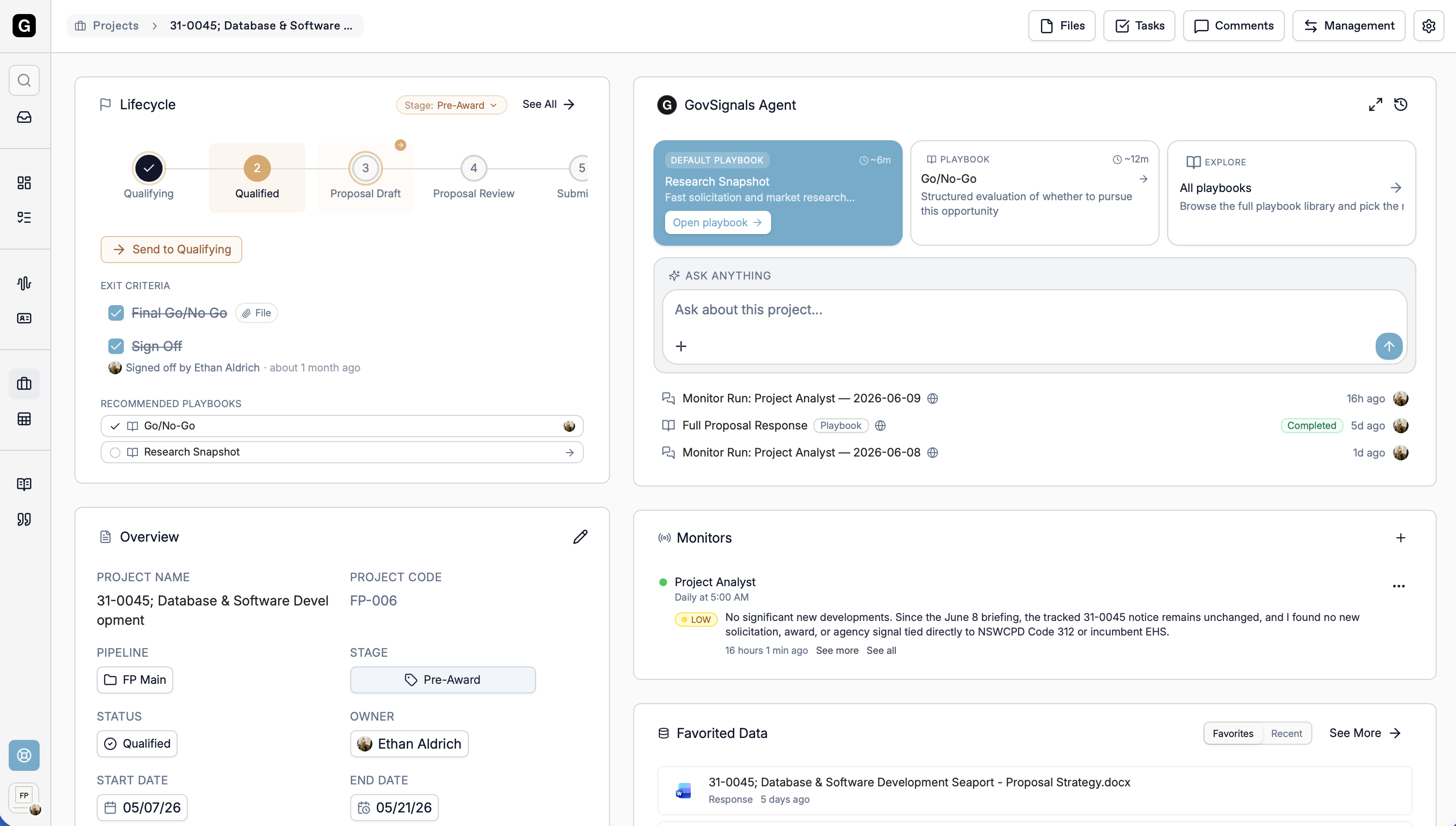
Real deliverables, assembled live.
Intelligence
The Intelligence agent ingests SAM.gov, agency forecasts, congressional markup, FPDS history, and unstructured open-source. Every signal is scored against your past performance and capture lists. You see only what fits.
Capture
The Capture agent drafts BD memos, builds competitor matrices, identifies teaming partners, runs gate decisions, and tracks pipeline through your stages. You stay in the chair it does the legwork, and shows the work.
Proposals
The Proposals agent ingests the solicitation, builds the compliance matrix, drafts every volume against your past winners and style guide, then runs pink, red, and gold team reviews. The team's job becomes deciding not typing.
Post-Award
The Post-Award agent watches every CDRL, every mod request, every ECP. Surfaces slippage three days before the COR does. Drafts mod justifications. Pre-stages the recompete narrative from the day of award because that's the contract nobody else gives you.


Real files. Your stack.
Ships in the formats you already use.
Every agent output is a real, editable document Word, PowerPoint, Excel, and PDF built to your templates and styles. No copy-paste from a chat window, no reformatting before it goes to the customer.


Lands where your team already works.
Deliverables round-trip through the systems you already run SharePoint, your CRM, and signoff tools so the work shows up where your team lives. Read-only adapters by default; nothing is pushed back unless you wire it up.


Not just a support team.
Real GovCon strategists.
Every engagement comes with a Deployment Strategist a senior GovCon operator whose only job is getting your team live and winning. They support you over chat and calls, and they own the deployment to a successful outcome.
The same platform, shaped for your shop.
Playbooks are verticalized GovSignals pre-loaded with the agency cadence, the form templates, the past-performance scoring, and the agent prompts that win in a specific corner of the federal market.
The SF330 Playbook
Sections A-H drafted, scored, and citation-anchored. 222-hour proposals built in a tenth of the time.
Go / No-Go Playbook
Fit scoring, incumbent pressure, competitive context, and an executive-ready bid/no-bid memo.
Market Intelligence Playbook
Forecasts, budgets, incumbents, early signals, and daily monitoring before the RFP drops.
Teaming Partner Research Playbook
Find firms that close capability, vehicle, set-aside, agency, and geography gaps.
Compliance Shred Playbook
Solicitation shred, Section L/M crosswalk, compliance matrix, and amendment deltas.
Shipley Review Process Playbook
Pink, red, gold, and executive reviews with structured packets and action synthesis.
Contract Parsing Playbook
Clauses, obligations, CDRLs, flow-downs, and risk notes ready for execution.